Showing posts with label gush etzion. Show all posts

Monday, September 16, 2013

Less Talk is Less Trouble

"And in the naked light I saw
Ten thousand people, maybe more
People talking without speaking
People hearing without listening
People writing songs that voices never share
And no one dared
Disturb the sound of silence.
'Fools', said I, 'You do not know
Silence like a cancer grows
Hear my words that I might teach you
Take my arms that I might reach you'
But my words, like silent raindrops fell
And echoed
In the wells of silence." - lyrics by Simon and Garfunkle
 
 
Perhaps like me, when you read the lyrics to his song or hear it playing over the radio you think, "how poetic, how beautiful, how powerful."  At least that's how I felt until this past Yom Kippur when I took a vow of silence for the day, a tanit dibur. 
 
Yom Kippur is the highest and holiest day of the year where we, the Jewish people, dress in white, we don't wear leather, we refrain from eating/drinking, we don't shower or brush our teeth, we refrain from marital relations and spend a day in prayer and reflection.  Leading up to this day we prepare by asking anyone who we may have harmed over the past year for forgiveness.  We physically, mentally, emotionally and spiritually prepare ourselves for our meeting with the Creator of Heaven and Earth.  We atone.  We afflict ourselves with many physical restrictions for the day and we prepare to ask Gd for another year of life, income, health, love, happiness.  We ask Gd to forgive us for our misdeeds, our broken promises, our gossiping, our selfishness, our transgressions.  I decided to add to this, without much prior knowledge of what I was getting in to, a 25 hour tanit dibur.
 
For the past few years of living in Israel I have heard stories of people who have completed a tanit dibur.  I honestly just thought it would be a nice break from small talk, not to mention probably nicer than talking to people with unbrushed teeth.  I truly had no idea what was in store for me.

Jeremiah HaNavi (the Prophet) compared speech to an arrow.  Once an arrow leaves the bow, it's gone.  The same applies to words.  No matter how deeply you regret saying something, once you said it, it has been said and it's out in the world.  Shelomo HaMelech (King Solomon) says that even a foolish person who is silent is considered wise.  If someone doesn't speak you will not find out how foolish he really is.  When a person thinks he's performing a very spiritual act, his Neshama is at work, and many times you have great ideas and they should be spoken, but think for a moment that you are taking something that is entirely spiritual, a thought, and turning it into a physical thing, a word.  When you think, you are in control of your body, but when you speak, your body is in control of you.

"Woe is to a man who lets something come out of his mouth who doesn't understand how he is saying it!  Every word that comes out of your mouth is written and recorded whether for good or for bad. (Midrash Tanchuma).  Can you imagine the scene in [Heaven] when they play everything you said?  You will realize that there are many things that you said that you wish you didn't!  The Zohar says that when a person is born, HaShem gives them a certain amount of words for a lifetime and after they use up that number, they cannot speak anymore!"

The bottom line is; How can you learn if you never listen!?  The Kotzker Rebbe says that our egos stand between us and HaShem, we speak so people will know how funny and smart we are.  Work on perfecting yourself on the inside and don't worry so much about what everyone else thinks. 

So I spent the day in silence.  

Thanks to a suggestion from a friend of mine, I made a card stating: "I'm sorry, but I'm in a tanit dibur. May you be inscribed in the book of life for the coming year."  If anyone tried to speak with me, I placed my hand on my heart as an apology and I showed them the card. 

A day of silence.  Can you imagine?  The only words I spoke were in prayer and repentance.  I "unplugged" and disconnected myself from my cellphone, computer, radio, iPod...small talk... everything.  One day of just me and just Gd. 

For me, someone who takes part in formalized and traditional prayer services, it seems to struggle at times to stay focused.  I mean, how do you make someone else's words meaningful each and every time you pray?  Sometimes, no matter how hard I try, it becomes mechanical.  Then when I try to speak my own private prayers from their heart, I often get side tracked and start thinking about the millions of other things I could be doing with my time.  *Sigh*  It's incredibly difficult to pour your heart out to Gd and to say what it is that you're sorry for, how you messed up, to ask for forgiveness, and to potentially ask for a few things that you need for the coming year... especially when we may suddenly develop ADD and the way the curtain is blowing next to the fan suddenly becomes much more interesting. 

Lets face it, we all do it sometimes.  We try to create a relationship with the Kadosh Barachu, but how do you create that connection with an intangible entity?  We're finite creatures attempting to have a conversation with Infinity.  I say, you should talk to HaShem like He's your best friend; tell the Holy One everything.  Easier said than done though.  I can sit here, close my eyes and say, "Ok Sarah, now's your chance.  What do you want to say?"  Only to draw a blank.

This Yom Kippur, my vow of silence (except in prayer) manifested into the greatest spiritual high and connection that I have ever felt.  The whole day was like a meditation.  Without the distractions from the outside world I found myself banging on my chest and saying every word of Viduy (Confession) with zeal that I've never felt before.  I stood before the Heavenly Court and chanted, "We have been guilty; we have betrayed; we have robbed; we have spoken slander.  We have committed iniquity; we have committed wickedness; we have sinned willfully; we have extorted; we have made false accusations.  We have given advice that is bad; we have been deceitful; we have scorned; we have rebelled; we have provoked [Gd's anger]; we have strayed; we have been iniquitous; we have sinned rebelliously; we have caused distress; we have stiffened our necks.  We have been wicked; we have been corrupt; we have committed abominations; we have gone astray; we have scoffed..."

As the day wore on (the hottest Yom Kippur Israel has had in 50 years, mind you) I weakly stood, energy dwindling, for the last hour and half of my fast and listened to the Chazzan's beautiful voice leading us through Nehila services.  I suddenly found myself uplifted.  24 hours and 45 minutes into a fast and vow of silence and I felt renewed, an extra burst of energy running through me.  I sang "Avinu Malkainu (Our Father, Our King), be gracious with us, and answer us, though we have no worthy deeds; treat us with charity and kindness and save us".  I yelled out with my congregation, "Shema Yisroel HaShem Elokanu HaShem Echad - Hear O Israel, HaShem is our Gd.  HaShem the One and Only".  At the sound of the last shofar blast... I was then transformed, energized and uplifted towards a different realm of personal clarity. 

The congregation burst into song and dance, "Next year in Jerusalem! L'Shana Habaa B'Yerushaliym!"  I bless us all that we may merit the building of the Holy Temple in Jerusalem.  I bless us all with peace, tranquility, love, laughter, health, and happiness. 

I sit now at the doorstep of Sukkot, the feast of the fall harvest.  Now, after having spiritually cleansed ourselves we will move outdoors into our temporary dwellings for the next week.  We will eat, sleep, and enjoy our friends a family in a temporary booth made of cloth, wood, and palm branches.  As we lie out under the stars, enjoy the moments of silence.  Listen to the crickets, listen to nature, listen to yourself.  Under the stars we can ponder Infinity and if we're lucky, hear it...

The sound of silence.

Saturday, March 23, 2013

Shabbat HaGadol


From Tekoa, my yishuv in the Judean Desert, I have the most amazing views.  To the East I can see the Dead Sea and Jordan.  To the West I can see all the way past Bethlehem to Jerusalem.  We, the Jews of Judea and Sameria (also known as the West Bank) are not necessarily the hill top religious radicals that are depicted on the news.  We, the Jews of Tekoa, are the peace yearning, Zionistic, musicians, artists, writers, inventors, scholars, and laborers of the “disputed territories”.  We are religious, secular, and traditional.  We are Jews from all around the world who are passionately Zionistic and are living with strength and emmunah - faith.  My fellow “settlers” have lived through the Gulf War, 2 Intifadas, motolov cocktails, and stone throwings.  They are the epitiomy of strength, patience, and love for humankind.

Two weeks ago during the passing of my Israeli community’s spiritual leader, Rabbi Menahem Froman, I finally truly realized what was important... peace.  Rabbi Froman was known as an eccentric “Settler” Rabbi from the West Bank Village of Tekoa... the place I call home.  

At Rabbi Foman’s memorial service he was eulogized as the ‘Rabbi of Peace’.  He was seen as sometimes controversial, but he was known as a man of principle, a man of vision, a man of holiness.  He was a man of genuine spirit and passion who stood up for what he believed in.  His message was about peace through understanding and compassion.  Not just from Jew to Muslim, but also Jew to Jew, and human to human.  I think that we, as human beings, can get so entangled in the monotony of everyday life that we forget the beauty that is all around us.  That is what he taught us.  How to find the inherent goodness in our fellow human being.

On that particular windy Tuesday afternoon, thousands of people gathered in my little village in the Judean Hills to pay tribute to a man of unwavering values.  As he was on the way to his final resting place we, roughly 5,000 people, stood grave side with his wife, children, and grandchildren.  Before he passed away, Rav Menahem requested that everyone sing the song; “Eshet Chayil” - A Woman of Valor to his wife, Hadassah.  It was a powerful expression of love, romance, loss, and support to be part of thousands of people singing together for them both.

The song Eshet Chayil - A Woman of Valor is found in the book of Proverbs (31:10-31).  The lyrics, accredited to King Solomon, paint a beautiful picture of this man’s love for his wife.
אשת חיל מי ימצא. ורחק מפנינים מכרה...
A Woman of Valor, who can find?  She is more precious than corals...
בטח בה לב בעלה.  ישלל לא יחסר...
Her husband places his trust in her and profits only thereby..
כפה פרשה לעני. וידיה שלחה לאביון...
She opens her hands to the poor and reaches out her hands to the needy...
עז והדר לבושה. ותשחק ליום אחרון...
She is robed in strength and dignity, and she smiles at the future...
פיה פתחה בחכמה ותורה חסד על לשונה...
She opens her mouth with wisdom, and a lesson of kindness is on her tongue...
רבות בנות עשו חיל ואת עלית על כלנה...
Her children rise up and make her happy; her husband praises her: “Many women have excelled, but you excel them all!”...
שקר החן והבל היפי. אשה יראת יי היא תתהלל: תנו לא מפרי ידיה. ויהללוה בשערים מעשיה...
Grace is elusive and beauty is vain, but a woman who fears Gd -- she shall be praised...

Author, Mrs. Lori Palatnik says that... “The Jewish woman. If not for her, the Jewish people would still be enslaved in Egypt.”

She continues by saying that, “when Pharaoh decreed that all first-born Jewish males should die, the men decided to refrain from relations with their wives so as not to bring any more children into this world. The women realized that Gd would indeed save them and bring them out of Egypt, so they went to their husbands in order to bring more Jewish children into the world. Their faith and foresight were said to have merited the redemption from Egypt of the entire Jewish people.”

She so eloquently points out that, “the Jewish woman [was] the one who was offered the Torah first from Moses. After Moses received the Torah from Gd at Mount Sinai, he offered it first to the Jewish women, for he knew that if they accepted it, it would become part of the Jewish people for all time.  It was the Jewish woman who, in the face of adversity, held steadfast to her trust in the Almighty, even when those around her did not.  The Jewish woman was who time and time again saved the Jewish people through her insightfulness, virtue, and belief in Gd.”

According to the Talmud, it is the Jewish woman, in whose merit the Messiah will come and the final redemption of the Jewish people.  

Today the Jewish woman, is the one entrusted with the responsibility of maintaining the three mitzvot central to the Jewish home: kashrut, Shabbat, and mikvah.

If not for her, where would we be? There would be no home, no family... no Jewish people. On Friday night, she sits as the queen of her table, while all those around her sing her praises. And rightly so.

She is the Eishet Chayil, the Woman of Valor, who sets the tone of love, spirituality, and personal growth for all those around her. To know her is to appreciate her strength and talents.

Rabbi Froman asking to have this song sung to his wife was a showing of true love and gratitude to his wife, Hadassah.

As we are now gathered here... together on this Shabbat, the Shabbat HaGadol, and look towards the coming days and the beginning of Passover we should be sure to remember from where we have come and to where we are destined to go.  We must remember that time is circular and not linear.  This is therefore the time of the Shabbat before the great Exodus from Egypt.  The Shabbat where we prepared lamb for dinner and painted our doorposts signaling the Angel of Death to pass over.  Our last moment of slavery and our transcendance to freedom.   This is the beginning of our true identity, the people of the book... our holy Torah.  50 days after the first seder we will celebrate Shavuot and the receiving of the Torah on Mt Sinai.  It is a time of great introspection and evaluation.  Are we still a nation of free people called the Jews?  Have we still been charged with the enormous task of being a light unto the nations?

At Rabbi Menahem’s funeral I saw my own understanding of these questions.  We are free.  We are free to choose who we want to be and how we will be that person.  We are free to truly understand one another and have compassion for one another.  We are free to open our minds and hearts to unwavering love.  Emancipated from physical, mental, and emotional slavery.  

As Rav Bob Marley says, “Emancipate yourself from mental slavery.  None but ourselves can free our minds.”  

I have been blessed to have moved to one of the most beautiful places in the world.  I am truly thankful each day that a pair of Divine Tweezers picked me up and plopped me down in the “West Bank”.  I was mentally enslaved into the entrapment of modernity.  Only looking outwards and never looking inwards.  That is my Exodus.  My own personal Exodus of self imposed shackles.  

I have been living in Israel for nearly three years now and this past November I got my first real taste of what it actually means to be Israeli.  Hundreds of rockets were fired into Israel from the Hamas run Gaza strip, reaching as far as Tel Aviv and even to my neighborhood, the Gush Etzion bloc of Judea.  One Friday night as I was home and lighting my Shabbat candles I heard a siren begin to wail through my village.  No one thought that we were in the range of rockets from Gaza, but still I ran to my secure room.  As I leaned out my window to grab and close my steel reinforced shutters, I saw two rocket trails over a neighboring hill followed by a BOOM BOOM!  I slammed my windows shut and sat in stunned silence.  Another siren began to wail, this time followed by an announcement, “Tzevah Adom, Tevah Adom, Code Red, Code Red.”  My permanent reality changed at this point in my life.  I am an Israeli now.  In the days following, I watched as my friend’s and neighbor’s husbands packed their bags and immediately left for reservists duty.  These brave souls proudly answering their call to duty are the modern day heros of the Jewish people.  Over and over again we are threatened with annihilation and over and over again we cry, “NEVER AGAIN!”  

So here we are roughly 3,300 years after leaving Egypt.  A free people.  We can live anywhere, we pray anyway, we are free to be us... Jews.  The champions of tikun olam.  Entrusted with the torch of not only just going out into the world to well, but going out into the world to do good.  

15 years ago I stood here, in this very place, as a scared and confused teenager declaring my disdain for what I believed was a cruel Gd... if Gd even existed at all.  I looked out into the world and I only saw darkness.  I saw no light, no holiness, no Gd.  I stand before you today as an equally confused adult, but a more humble one and a person who yearns only to find the good, beauty and holiness in this world.  I have learned that when I screamed and yelled for Gd to answer me and was so positive that Gd was not there that it was not Gd who had gone anywhere... it was me.  As soon as I came back to see if Gd was still around... there He was waiting to embrace me like a parent embracing their child, welcoming them home.

I have learned from living on a yishuv (aka settlement) the true meaning of peace and harmony.  I have allowed myself to focus on the light in the world instead of the darkness because out of the darkness comes light.  In the darkest places we can light a candle that’s brightness will spread and illuminate.  It is the light of hope and emmunah.  

Friday, March 8, 2013

Settlers


This fantastic piece was written by a friend and neighbor of mine when we took a creative writing class together here in Tekoa.  Thank you Debbie for allowing me to share.  


== SETTLERS == 
by Debbie Rosenzweig

“Oh, you look different than I expected,” she observed aloud, scanning me from top to bottom and back again over her maroon plastic rimmed glasses. She clearly considered it a compliment, smiling as she edited the data entry she had filed away about me in her brain based on our previous conversations. Gila is the distributor of one of the English text book companies that I use to teach my students in the elementary school in Tekoa, a village located in the Gush Etzion settlement of the West Bank. Like other places of a similar status, Tekoa is considered legal by Israeli law and illegal by international law; the strongest safeguard of our security by some, the strongest obstacle to peace by others; the essence of our heritage and identity by some, the epitome of racism and apartheid to others.

Gila and I were meeting to discuss the most effective way in which to use the text books. After several obnoxious phone conversations, we had decided to meet in a coffee shop in Jerusalem, because she refused to cross “the Green Line” to get to the dangerous settlement I call home, no doubt picturing a smattering of caravans studded with bullet wounds, personally guarded by gun-toting religious fanatics foaming at the mouth.

“What did you expect?” I challenged, as I sat in the empty chair beside her. My response threw her off guard, as I knew it would. “Oh, I don’t know,” she stammered, “how long did it take you to get here?” Classic subject change. “Ten minutes,” I shrugged triumphantly, choosing to trim it down by eight minutes to make her feel stupid, instead of exaggerating in the opposite direction to make her feel guilty about dragging me out here. “That’s it?” she blurted out, surprised.  “Sure,” I responded nonchalantly. Mission accomplished.

Over the course of the following hour and a half, Gila repeatedly complimented me on my intelligence, my analytical skills, and my concern for the students, noting in typical Israeli fashion that she really hadn’t liked me over the phone. Thanks. The feelings are mutual. My disdain for her increased with each patronizing accolade, culminating with her final confession: “I just thought you were going to be, like a – like a – mitnachelet!” she confessed, referring to a female settler, often seen wandering suspiciously through illegal territories wearing far too much mismatched fabric, splattered with the vomit of her own babies and the blood of her neighbors, leading a pack of wild, predominately male children with matching fleeces and disheveled sidelocks, tzittzit blowing furiously in the desert wind.

“There are all sorts of people in Tekoa,” I explained, exhibiting great intelligence and concern for my ignorant, offensive student, “secular, religious, American, Russian, French…”. “French?!?” she interrupted, trying to Photoshop a cultured European with high heels and even higher moral standards into her image of the occupied territories. We soon wrapped up the meeting and promised to be in touch, but our interaction stayed with me as I caught busses and hitchhikes back to my home, such a mystery to so many people in this country.

Just over half a year ago I was busy with my own deliberations about moving here; what about convenience, security concerns, political statements, community? I had recently returned from several months of volunteering in Nepal with an Israeli NGO along with American and Israeli Jews, mostly secular, anti-capitalist, vegetarian left -wingers who looked at me and my bearded, skullcap wearing then-fiancé with confusion and distrust. After months of building relationships, breaking stereotypes, and pretending to help disadvantaged Nepali children, I told one of my friends that we were thinking of moving to Tekoa. “I’m sorry I won’t be able to visit you there,” she explained, “but I refuse to go somewhere that I am so ideologically opposed to.” When she did come visit months later, she was shocked by what she saw – long-legged Russian women in short shorts walking their dogs, secular and religious teens hanging out together at the pool, beautiful, permanent homes with lovely gardens, and a breathtaking view of the Judean desert.

A place which seeks to both destroy labels and respect those that others choose to use forces us to challenge our prejudices while maintaining our sense of hard earned identity and lifestyle.  I remember the confusion I experienced when I left seminary and went to study in Bar Ilan University. I had self righteously donated all my pants and immodest clothing to charity and moved to Israel, to what I thought was a holy world of black and white capital T truths, only to date a religious guy who didn’t believe in the messianic redemption, learn heresy from highly respected Jewish history and philosophy professors, and see young married women wandering around campus in head scarves and pants. Pants! I resisted such dangerous temptations, holding on to the absolute truths that had given me no choice but to abandon my family, friends and lifestyle to move to a warzone, yet the world I was building for myself was already starting to shake.

Now, several years later, I find myself at home here, in this pluralistic, mixed settlement, representing people all across the religious, ideological, ethnic and cultural spectrum. I take great pleasure in being unable to tell which of my students are from observant homes, in not having to worry about being judged by my outfit, in hearing Spanish, Russian, French, Hebrew and English in the streets, in sharing my space with people who are different from me, and, of course, in sticking it to the Gilas of the country, showing them what a true mitnachelet is really like.

Tuesday, March 5, 2013

Rav Menahem Froman

Baruch Dyan HaEmet - Blessed is the righteous judge...

I've never seen so many people in my little yishuv that roughly 600 families call "home".  On a brisk and blustery Tuesday afternoon thousands of people from all over Israel gathered to honor the life of Rabbi Menahem Froman.  Rabbi Menahem was the Rabbi and spiritual leader of my yishuv, Tekoa.  I've never experienced anything like this in my life and I will be eternally grateful that I had the opportunity to live and pray in his community and synagogue.


In a land of indescribable amounts of conflict Rav Froman was a champion of peace.  He passionately worked for what he believed in.  He tirelessly worked to find a solution, peace, and understanding with our Muslim cousins.  


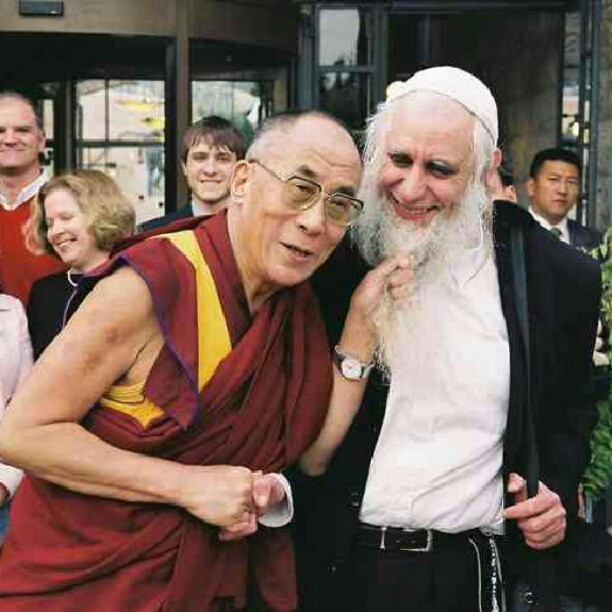
The first time I saw Rabbi Froman was at an annual festival held here in Tekoa called 'Hoshana Raba' marking the end of Sukkot.  I had never seen anyone radiate purity, innocence, light, and holiness like this man.  Dressed in all white, long white beard, a smile that's can only be described as magical, and eyes that sparkle with a light from another world.  He was on the main event's stage with a major Israeli musician, Ehud Banai, smiling and clapping and lighting up the audience with a radiance that is nothing short of contagious.  


As an immigrant I have been new to the Rav Froman phenomenon and idea of peace through religion.  His controversial ideas of achieving peace are simplistic and complicated and beautiful all at the same time.  His light shines on through his wife, 10 children, and grandchildren.  Their smiles radiate as brightly as his did.  Their energies and passion are as big as his was.  I am humbled to have briefly known him and his family.

MK Uri Ariel (Jewish Home) addressed on Monday night the passing of Tekoa's Rabbi Menachem Froman, who died after a battle with colon cancer.  "This was a great loss for the country. Rabbi Froman was one of the greatest fighters and lovers of the country. He loved peace and pursued peace, hated controversy, loved people and drew them closer to the Torah. He was always able to see the person beyond the dispute and to connect the different factions of the nation."

As I walked with the thousands of admirers and supporters from my synagogue to the cemetery I was lost in my own silent awe and admiration for this man.  The wind furiously blew us along the way we sang songs and hymns as we walked him to his final resting place.  


The head of the Shomron Regional Council, Gershon Mesika, expressed deep sadness over the passing of Rabbi Menachem Fruman Monday night.  "Israel and the communities of Judea and Samaria have lost an important spiritual leader. Rabbi Menachem Fruman worked all his life in original and varied ways to strengthen and expand the settlement and construction in Judea, Samaria and all of Israel. The residents of Samaria express their condolences to the family, the community of Tekoa, Gush Etzion and all of Israel. "
The young leaders of the Jewish Home party expressed their sorrow Monday night over the passing of Rabbi Menachem Fruman.  "The Rabbi was a brave man, a man of truth who was not afraid to go against the current, even when it was not easy. The Rabbi was a very special personality and knew how to integrate world views and differing opinions. A man of peace and love."


=====